
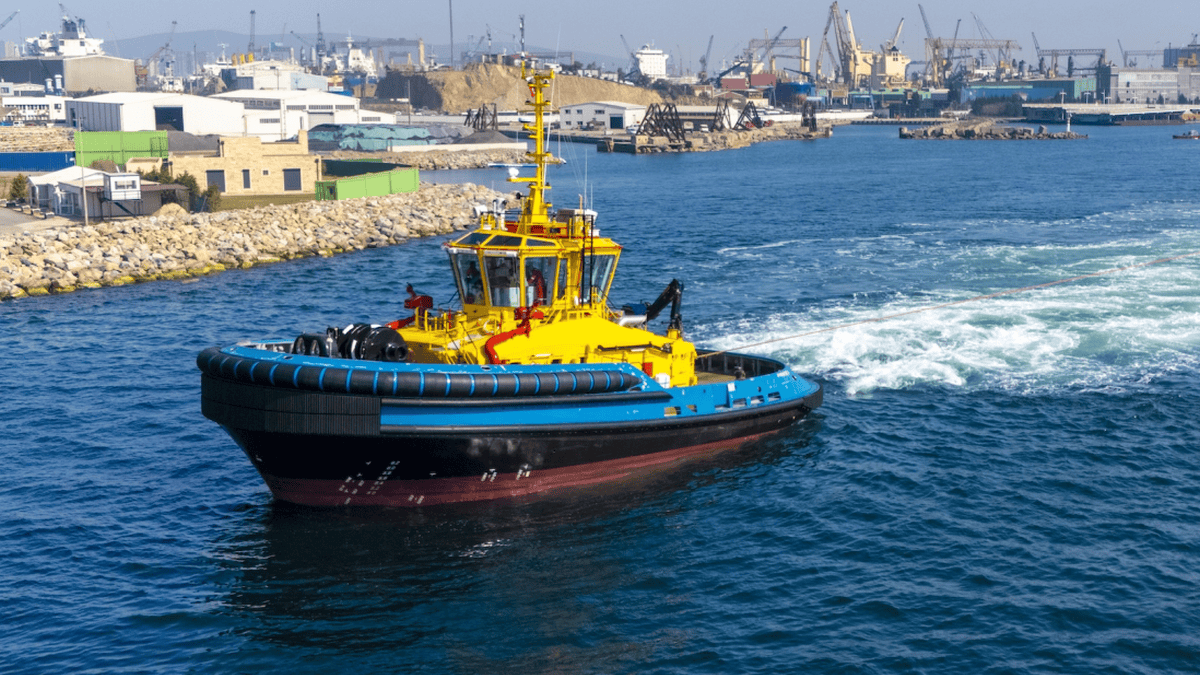
Tugs are being built with higher-capacity energy storage systems on board to provide zero-emissions towage in harbours, while new technologies are promising greater power storage and longer life
Energy storage is increasingly part of the conversation for propulsion systems on board tugs and workboats, when owners need to lower emissions.
Battery systems are now well established in harbour applications, with suppliers reporting rapid improvements in storage capabilities, performance and falling costs.
Around 60 tugboats operate with battery-hybrid propulsion, where the energy storage system (ESS) has a dominant role in providing power to the thrusters, according to data accumulated by International Tug & Salvage.
Of these, 20 were built in 2025 at shipyards in China, the Netherlands, Spain, Turkey and Vietnam, with some yet to be delivered.
About 50 tugboats are under construction or on order, which will have large-scale ESS units powering their propulsion, with a diesel generator as back-up.
Many ESS modules installed on tugboats are from specialist companies such as Norway’s Corvus Energy, but more are being supplied by companies such as ABB, AYK Energy, Echandia, EST-Floattech, Kongsberg Maritime and Toshiba.
“We have experienced a roughly 10%-15% improvement in capacity”
Corvus Energy vice president Tuomo Salmi said there has been increasing demand for ESS modules with higher storage capacities and quicker recharging than earlier generations.
“We have experienced a roughly 10%-15% improvement in capacity year to date, and we expect this will continue,” he said.
Battery integration is already reshaping vessel design, even in the tugboat and workboat sector, where there is limited space and high power requirements.
“High-performance tugs are already here,” Mr Salmi said. “Tugs are at the forefront of maritime electrification.”
In Q4 2025, Corvus Energy introduced its next-generation ESS with a longer life and greater charging capacity for vessels.
Blue Whale NxtGen has higher energy density than previous marine batteries, cobalt-free lithium iron phosphate (LFP) cells, a prolonged lifetime of up to 15 years and a 1C charge and discharge rate.
Battery components for these ESS modules are supplied from Chinese factories, with system integration on vessels completed in shipyards.
In December 2025, Corvus signed a memorandum of understanding (MoU) with BYD Energy Storage to collaborate on advancing next-generation battery solutions in the maritime sector, concentrating on LFP technology.
In February, four tugs with Corvus ESS on board were named at one of Sanmar’s shipyards in Turkey after they were built for Botas.
In January, Uzmar launched the world’s first battery-methanol tug, Svitzer Balder, with a 6-MWh ESS on board.
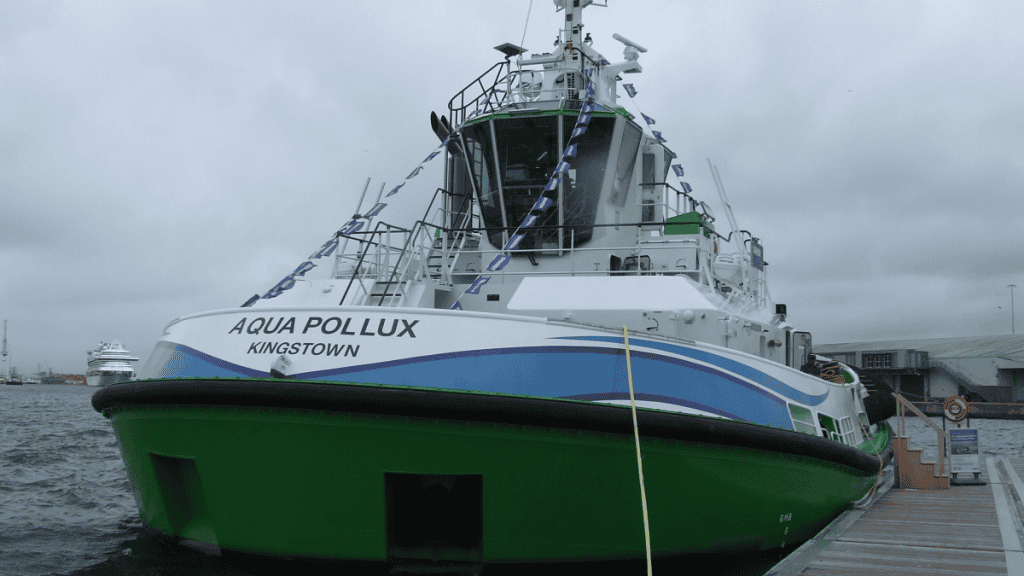
Damen Song Cam Shipyard builds battery-electric tugs, such as Aqua Pollux, to a RSD-E 2513 design (source: Riviera Shipyards)
AYK Energy is constructing its ESS for tugs, icebreakers and other workboats in China and supplying them to propulsion system integrators.
It recently signed a contract to supply a Pisces+ battery system with a capacity of 16 MWh for Germany’s Polarstern research and icebreaking vessel..
Wärtsilä will integrate this 131-tonne unit in a hybrid-electric propulsion system on this vessel, ready for delivery in 2028.
Echandia has secured a contract to supply a 3-MWh ESS with lithium titanium oxide batteries and a 25-year lifetime for a tugboat being built to operate in Singapore’s harbour.
The Swedish manufacturer also gained a deal to supply a 4.4-MWh battery system for an electric tug that Mandovi Drydocks is building in India for Ripley Group to operate in Kandla Port.
EST-Floattech supplies ESS units for battery-powered inland waterway pusher tugs built and operating in the Netherlands.
Toshiba ESS units are used on reverse stern drive tugs that Damen Song Cam Shipyard built in Vietnam, including three operating in the UAE, one in New Zealand and at least two in northern Europe.
Technology drives
New battery technologies are entering the market for onshore and marine applications promising higher storage capacity, extended life, shorter charging times, and a lower environmental impact and cost.
Integrals Power has tested a lithium manganese iron phosphate (LMFP) battery in the UK and considers it applicable for automotive, maritime, aerospace, and defence sectors.
Its pilot LMFP battery cells have now passed 1,500 charge cycles in independent testing by QinetiQ while retaining nearly 80% capacity. Separate testing by Cranfield University has demonstrated these cells maintain 85% capacity at -25°C and 68% at -30°C, giving them the potential to be used for polar operations. The current benchmark LFP and LMFP cell chemistries typically deliver only around 50% at -25°C and 40% at -30°C.
Raw materials were sourced from Europe and North America, demonstrating how next-generation cell chemistry can help overcome the global industry’s reliance on China for these resources.
UK-based Eqonic Group has developed battery technology that is free of lithium, sodium and rare-earth elements, thus achieving cost savings of around 70% compared with traditional lithium batteries.
It plans to license its technology to established OEMs, reducing capital risks while enabling rapid global deployment.
Eqonic said its composite materials are inherently non-flammable, reducing the risk of thermal runaway and fire. It plans to surpass sodium battery performance in 2026, exceed LFP by 2027, and achieve NMC levels by 2029.
Marine power electronics (PE) specialist The Switch is realigning its Vaasa operations in Finland to strengthen production output amid accelerating vessel electrification.
It is establishing a second hub for PE production and testing alongside its existing base in Stord, Norway.
Proven production methods developed in Stord are being transferred to Finland to ramp up output and avoid production bottlenecks.
Until now, manufacturing and testing of The Switch’s PE portfolio – including DC-hubs, single drives and power modules – has been concentrated in Stord.
While that site remains a core centre of competence, it has reached full capacity and acceptance testing of DC-Hubs is resource-intensive.
The company expects that a second site will enable work to be shared and will eventually shorten delivery times.
Taken from Rivera, written by Martyn Wingrove on 18 March, 2026